




A major shift in how customers are identified on WhatsApp
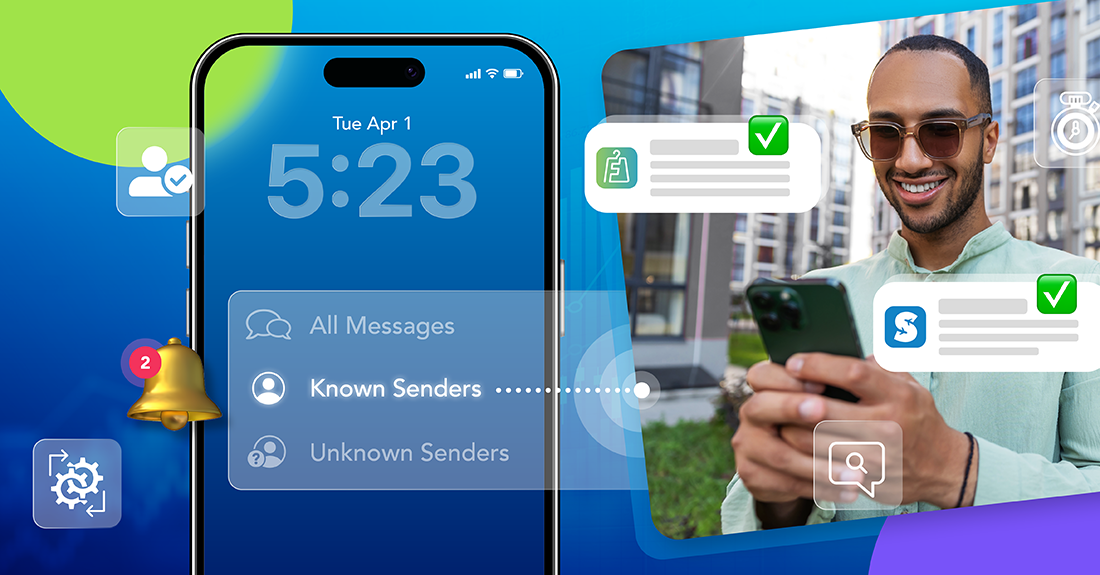
WhatsApp’s new business-scoped user ID (BSUID) marks an important change for businesses that use the WhatsApp Business API. As usernames roll out to end users in 2026, some customers will be able to contact businesses without sharing their phone numbers. Instead of relying only on a phone number (MSISDN) as the customer identifier, businesses will need to support BSUID as part of their messaging, routing, and customer data workflows.
Phone numbers are not being removed, however, customers will now have more privacy options. When a customer chooses to use a username, businesses may see a BSUID in places where they previously expected a phone number.
What changes technically when BSUID arrives
From a technical perspective, BSUID changes what businesses can expect to receive in webhook payloads and what they must be able to send back in API requests. In practical terms, the identifier shown in sender and recipient fields may no longer always be a phone number. Depending on the scenario, your systems may receive a phone number, a BSUID, or both. That means any logic built around MSISDN-only assumptions—such as routing, contact matching, conversation history, attribution, or campaign targeting—needs to be reviewed and updated.
BSUID is designed to be stable for the relationship between a specific customer and a specific business. In other words, the same customer can have a different BSUID with different businesses, but for your business, that identifier remains the one you should store and reuse for future interactions. Supporting this properly is essential if you want your integration to continue working seamlessly once more customers start using usernames instead of exposing their phone numbers.
For clients using Chat Flow, in a flow expression, [[session:channelUserId]] will act as a generic catchall for BSUID and MSISDN. BSUID must be supported in all flows.
Will there be any changes to OneAPI?
Yes. The following changes are applicable:
1. Sending Messages
The `to` field now accepts either a phone number or a BSUID:
``json

// Sending to a phone number (unchanged)

{ "to": "27835544524", "content": "Hello!" }

// Sending to a BSUID (new)
{ "to": "ZA.9373795779eb6441c8adb2eaee5b848e7dd174ddd302d7db62142f4722d574b6", "content": "Hello!" }

```
There are no new fields to learn. It is the same `to` parameter, with a new accepted format.
Note: Authentication templates (one-tap, zero-tap, copy-code) still require a phone number. Sending these to a BSUID returns error `Delivery Failure (23)`.
2. Receiving Messages (Inbound Callbacks)
Three new fields have been added to the `whatsapp` object in MO callbacks:


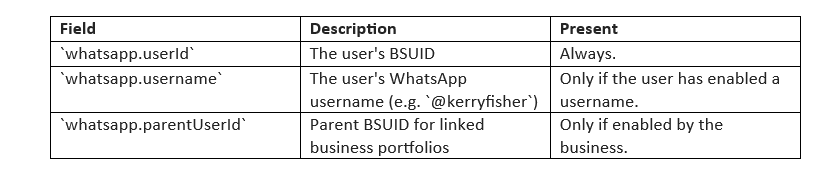
The `from` field now contains:
The phone number (when available — as is currently done)
The BSUID (when the phone number is unavailable)
Example: User with username, no phone number available:
{

 "from": "ZA.9373795779eb6441c8adb2eaee5b848e7dd174ddd302d7db62142f4722d574b6",

 "to": "2799900002",

 "content": "Does it come in blue?",

 "whatsapp": {

  "profileName": "Kerry Fisher",

  "username": "@kerryfisher",

  "userId": "ZA.9373795779eb6441c8adb2eaee5b848e7dd174ddd302d7db62142f4722d574b6"

 }

}
Example: User with username, phone number still available:
{

 "from": "27835544524",

 "to": "2799900002",

 "content": "Does it come in blue?",

 "whatsapp": {

  "profileName": "Kerry Fisher",

  "username": "@kerryfisher",

  "userId": "ZA.9373795779eb6441c8adb2eaee5b848e7dd174ddd302d7db62142f4722d574b6"

 }

}
3. Status Callbacks
No changes. Delivered/read/failed callbacks remain unchanged.
💡Developer takeaway: Build for both scenarios from the start. Some messages will include a phone number and a BSUID, while others may include only the BSUID. Systems that can gracefully handle both will be far better prepared for the rollout.
💡Important information for developers: Business-Scoped User IDs — Meta for Developers
Why CRM and customer data models need attention
For many businesses, the most significant impact of BSUID will be in the CRM. If your customer records, chat histories, or automation flows rely on phone numbers as the primary key, then this update introduces a new reality: some customers may arrive without one. That makes it critical to rethink how identities are matched and how records are maintained over time.
A practical approach is to treat BSUID as a primary identifier for WhatsApp interactions and then enrich customer records through in-conversation data capture or other approved linking methods. Historical chat history does not disappear, but businesses may need logic to merge or reconcile records if a customer later shares a phone number after initially interacting through a username. The key design principle is flexibility: your data model should support both identifiers, rather than assuming one will always be present.
How to prepare your integration before the rollout
If Clickatell manages your integrations, we'll make the necessary changes to ensure that you're prepared for this update. Your TAM will get in touch with you if there is anything specific to your account.
If you manage your own integrations, you will need to make sure that your systems are prepared. The below checklist can be used as a guide:
Audit every system that reads or writes a WhatsApp phone number.
Add a BSUID field to message, contact, and integration schemas.
Update routing, CRM linking, chat history, attribution, and campaign logic to support either identifier.
Review bots and automations that assume an MSISDN is always present.
Test sandbox and production-like scenarios before broader rollout milestones later in 2026.
Decide whether supporting contact-book style resolution features makes sense for your business model.
Our TAMs and Support team are on standby to assist you, should you need it.
What happens to the BSUID when a phone number is changed or recycled?
There are two distinct scenarios:
Scenario A: A user changes their number using WhatsApp's Change Number feature.
This is fully supported by Meta. Webhooks are provided to link the old and new BSUIDs, allowing continuity of the user record.
When a user changes their number through WhatsApp:
The user's identity remains the same.
A new BSUID is generated for the business portfolio.
The user's username, if applicable, remains associated with the account.
Meta provides two webhook notifications:
A system message webhook with type: user_changed_user_id, which includes the old and new BSUIDs, as well as the new wa_id, user_id, and parent_user_id (if applicable).
A user_id_update webhook containing structured previous and current BSUID values, along with parent BSUID details where relevant.
Recommended CRM action: Link the old BSUID to the new BSUID to maintain a continuous customer record. Meta does not specify what happens to the old MSISDN on the carrier network after the number change.
Scenario B: A user relinquishes a number and the carrier later assigns it to a different person.
This is not explicitly covered in Meta's BSUID documentation, however, the expected behavior can be inferred from Meta's platform design and WhatsApp's recycling safeguards.
If the previous WhatsApp account has been inactive for more than 45 days when the new user registers, WhatsApp removes the old account data before completing registration. The new user starts with a clean account and no inherited conversation history.
Implications for the Business Platform:
The new user receives a completely new BSUID.
No user_changed_user_id webhook is triggered, as this event only applies when the same user changes numbers.
No user_id_update webhook is triggered, as the BSUID change does not relate to the same user.
Meta does not provide automatic reconciliation between the previous and new BSUIDs.
The previous user's BSUID remains in your CRM unless actively managed.
Additional considerations:
If the previous user was messaged within the last 30 days, the phone number may still appear in webhooks due to Meta's per-business phone number cache.
If Contact Book is enabled, historical phone-to-BSUID mappings may still exist.
From a platform perspective, this appears as a new BSUID associated with a phone number that may already exist in your records.
Meta provides only limited guidance on what happens to a username after a number is recycled. Usernames are linked to the WhatsApp account, and not the phone number itself. When an account is removed as part of the recycling process, the username is no longer associated with that account. Meta states that: "If deleted, the username may eventually become available for another user."
Meta does not publish timelines for username reallocation and does not describe whether a new user registering on the recycled number can claim the previous user's username. The only documented constraint is that usernames must be unique across WhatsApp and each user may have only one username.
How is Clickatell preparing for this change?
Introducing: The Clickatell Contact Book
Bridging BSUID and MSISDN — with consent at the core.
We've heard the concern from many of you: "How do I keep my CRM, marketing attribution, and cross-channel identity working when half my customers go BSUID only?" That's why we're launching the Clickatell Contact Book — an optional, opt-in service for Chat Flow customers.
What It Does
Meta's BSUID model exists to give end users more privacy, and we respect that fully. The Contact Book is engineered as a consent-driven, legally bounded bridge. It does not bypass any WhatsApp privacy controls. It only resolves identifiers where consent and contractual obligations are satisfied.
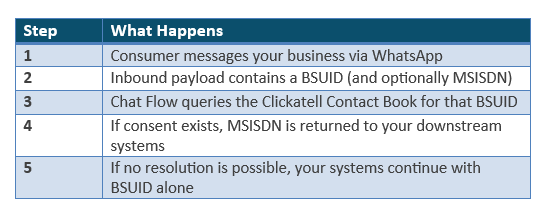
The Contact Book lets Chat Flow users resolve a BSUID back to its underlying MSISDN (where the customer has consented at the WhatsApp level), so that:
Existing CRM records keyed on phone numbers continue to match
Marketing attribution and campaign lists remain intact
Cross-channel identity (SMS + WhatsApp) stays unified
Chat history is not fragmented across identifiers
This is not a default service, and the following is required:
Formal customer opt-in by your business.
Signed Clickatell Contact Book Agreement by your authorized signatory.
The agreement covers:
• Scope of data resolution and permitted use
• Data protection and privacy (GDPR, POPIA, CCPA where applicable)
• End-consumer consent obligations
• Liability and indemnification
• Data retention and deletion policies
No BSUID resolution will occur on your account until both opt-in and the signed letter are complete.


Want to discuss whether the Contact Book fits your use case? Reach out to your TAM today.








Step into the future of business messaging.
SMS and two-way channels, automation, call center integration, payments - do it all with Clickatell's Chat Commerce platform.

